





How Can AI Be Integrated Into Your Business? Opportunities, Costs, and Where to Start
Blog Detail

Last Updated on
“We’re interested in AI, but where do we actually start?”
It’s a question we’re hearing more often.
Not from technology teams. From business owners. Managing directors. Operations managers. People who know artificial intelligence is imperative but aren’t entirely sure where it fits into their organisation.
And honestly, that’s understandable.
Most businesses need faster processes, fewer repetitive tasks, better customer experiences, and more time for their teams to focus on valuable work.
AI just happens to be one way of achieving those goals.
According to Gartner, 54% of business leaders have already introduced automation into key areas of their operations to improve efficiency and reduce manual work. The conversation has shifted to “Where will AI make the biggest difference?”
The answer is usually simpler than people expect. Every business has different processes, challenges, and priorities. What works for one organisation may not deliver the same results for another. That’s why AI consulting often starts by understanding how a business operates today, identifying areas of friction, and uncovering opportunities where AI can create measurable value.
What does AI integration actually mean for a business?
One of the biggest misconceptions is that AI integration means replacing people. In reality, most successful AI projects have very little to do with replacing jobs. They’re about removing friction.
Think about how many processes inside a typical business still rely on someone manually moving information from one system to another. Or how often teams spend hours chasing approvals, updating spreadsheets, responding to routine enquiries, or generating reports.
Those activities keep businesses running. But they rarely create value.
AI integration simply means introducing intelligent automation into those processes.
Sometimes it’s a chatbot.
Sometimes it’s document processing.
Sometimes it’s a workflow running quietly in the background that nobody even notices.
The best AI projects often start with a simple question:
“What is wasting the most time today?”
That’s usually where the opportunity sits.

Where can AI deliver the biggest impact? – 6 Use Cases
Not every department sees the same benefits. But there are a few areas where businesses are consistently seeing measurable results.
1. Customer support
Most support teams spend a surprising amount of time answering the same questions. Appointment updates. Delivery information. Password resets. Account enquiries.
One enquiry takes two minutes. Then another arrives. Then another. Individually, they’re small tasks. Collectively, they can consume hours every day.
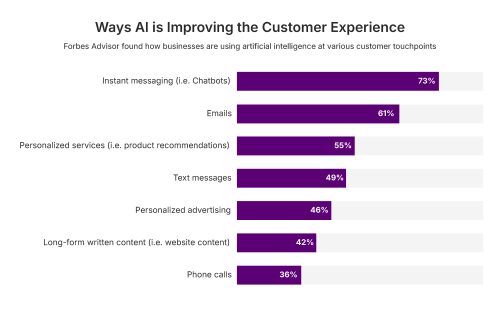
AI-powered chatbots and virtual assistants help businesses handle many of these routine interactions automatically. This allows support teams to focus on more complex customer issues.
Interestingly, a Forbes report found that 64% of business owners expect AI to help them build better customer relationships.
2. Sales and lead generation
Ask most sales teams where their time goes.
Very few will say selling.
A lot of it disappears into prospect research, CRM updates, follow-up emails, qualification processes, and administration. AI can help identify high-potential prospects, enrich lead data, score opportunities, and automate parts of the sales process.
The result isn’t always more leads. Often, it’s less wasted effort and better-quality conversations. This is how AI reduces costs and boosts profits for businesses.
3. Marketing
Marketing teams have never had a shortage of data.
Website traffic. Campaign performance. Email engagement. Social media metrics.
The challenge is making sense of it all.
AI can help identify trends, spot opportunities, and personalise campaigns. The technology uncovers insights that might otherwise be missed. It can also reduce some of the manual work involved in campaign management and reporting.
That means marketers spend less time pulling reports together and more time acting on them.
4. Operations
This is where many businesses see their quickest return. Not because operations are exciting. Usually, because they’re full of repetitive tasks that nobody enjoys doing.
Approvals. Scheduling. Resource allocation. Internal requests. Workflow management.
A few minutes here and there doesn’t sound like much. Until you multiply it across dozens of employees and hundreds of tasks every week.
AI can automate many of these activities, helping businesses operate more efficiently without increasing headcount. According to Forrester, AI will augment 20% of jobs over the next five years rather than eliminate them, making employee upskilling essential. An AI development company can help identify operational bottlenecks and automate routine workflows.
5. Reporting and analytics
Most businesses already have the data they need. The problem is getting useful information out of it. Many management teams still rely on spreadsheets, manual reports, and time-consuming analysis.
AI can process large volumes of information quickly, identify trends, highlight anomalies, and generate insights in minutes rather than hours. Analytics and business intelligence continue to be among the fastest-growing areas of AI adoption globally.
For many organisations, faster reporting leads directly to faster decision-making.
6. Document processing
This is probably one of the most overlooked opportunities.
Invoices. Contracts. Applications. Compliance documents. Internal forms.
Businesses generate enormous amounts of paperwork. Someone usually has to read it, extract information from it, classify it, store it, or approve it.
AI can automate much of that process. It’s not particularly glamorous. But it can save significant amounts of time. And sometimes that’s exactly what businesses need.
The right way to introduce AI into your business
One pattern appears repeatedly in successful AI projects. Businesses start small. They don’t try to transform every department overnight.
Instead, they choose one process that’s creating frustration.
Maybe it’s customer enquiries.
Maybe it’s reporting.
Maybe it’s document approvals.
They solve that problem first.
Once the value becomes visible, expanding AI into other areas becomes much easier. By starting with a focused use case, businesses can measure the impact, understand what works, and build confidence across teams. It also reduces risk and avoids investing heavily in technology before there is a clear business case.
How much does AI integration cost?
The honest answer is that it depends on what you’re trying to achieve.
A simple AI chatbot or workflow automation project may cost a few thousand pounds. More advanced solutions involving custom development, multiple system integrations, or AI-powered platforms will require a larger investment.
The bigger question is often not the cost of implementation but the cost of doing nothing. If teams are spending hours every week on manual processes, reporting, data entry, or repetitive customer enquiries, those inefficiencies carry a cost too.
This is why many businesses begin with a small, focused project. It allows them to test the technology, measure the return on investment, and build a business case for wider adoption.
Most successful AI projects are not driven by technology alone. They are driven by a clear operational challenge and a measurable outcome.
Final thoughts
AI integration doesn’t need to begin with a huge investment or a complete business transformation.
In fact, the most successful projects often start with something relatively ordinary.
A repetitive process.
A reporting bottleneck.
An operational headache.
The businesses seeing the strongest results are not necessarily using the most advanced AI tools. They’re simply applying AI to problems that already exist.
And that’s often the best place to start.
Frequently asked questions
How can AI be integrated into my business?
Start by identifying repetitive tasks, manual processes, or operational bottlenecks. AI can then be integrated into existing systems and workflows. It can support customer service functions, reporting tools, and business applications.
How much does AI implementation cost in the UK?
Costs vary significantly depending on complexity. Smaller automation projects may start from a few thousand pounds, while bespoke AI platforms and enterprise solutions typically require a larger investment.
Is AI suitable for small businesses?
Yes. Many small and medium-sized businesses are already using AI to automate support, improve reporting, streamline operations, and reduce manual administration.