





How chilliapple is Delivering a Bespoke Asset Management Solution for JBS
Blog Detail

Last Updated on
Anyone who has worked on large-scale building surveys knows how quickly asset verification can become complicated.
A client sends over an asset register. Engineers head to site. Some assets are missing, some records are incomplete, and others no longer match what exists in the building. Add thousands of assets, multiple locations, photographs, condition assessments, and reporting requirements into the mix, and even a straightforward project can become difficult to manage.
This was the challenge facing Jaguar Building Services (JBS).
Recently, chilliapple, a software development agency, partnered with JBS to help modernise this process. As the business continued supporting clients across a growing number of properties, the limitations of spreadsheets, manual data collection, and disconnected reporting workflows were becoming increasingly apparent.
JBS needed a more practical way to verify assets, support engineers in the field, and create consistent reports across every project. This blog explores how we designed and built a bespoke platform to help achieve that goal.
About Jaguar Building Services
Jaguar Building Services (JBS) provides building maintenance and asset-related services across a variety of client sites.
A significant part of their work involves verifying asset registers, confirming equipment details, recording site observations, capturing photographic evidence, and producing detailed reports for clients.
Traditionally, much of this work relied on spreadsheets, manual updates, and disconnected processes. While the approach worked, it became increasingly difficult to maintain consistency and visibility as projects grew larger.
The challenge
Every project started with an asset register. The problem was that no two registers looked the same. Some were well organised. Others contained missing information, duplicate records, inconsistent naming conventions, or incomplete asset details.
Field engineers were responsible for physically verifying assets across buildings, often working through thousands of records during a single contract.
Along the way, they needed to:
- Confirm asset information
- Record missing assets
- Capture photographs
- Assess asset conditions
- Add notes and observations
- Produce information required for final reports
Connectivity presented another challenge. Engineers frequently worked in plant rooms, basements, and service areas where internet access could not be relied upon.
Meanwhile, management teams needed better oversight of project progress, survey completion rates, and reporting activity.
JBS needed a solution that could bring these activities together into a single, consistent workflow.
What JBS was looking for
The goal was not simply to replace spreadsheets. JBS wanted a platform that could support the entire asset verification process, from importing client asset registers through to producing final reports.
Key requirements included:
- Importing and mapping client asset data
- Offline asset verification
- Photo and media capture
- Asset condition assessments
- Survey progress tracking
- Centralised administration
- Consistent report generation
- Better visibility across projects
Most importantly, the solution needed to work in real-world field conditions where internet connectivity could not always be guaranteed.
Our approach
Rather than creating separate tools for different parts of the process, we designed a connected solution consisting of a web-based administration platform and a dedicated mobile application for surveyors.
This approach allowed office teams and field engineers to work from the same dataset while supporting offline inspections and centralised reporting.
What we built for JBS
1. A centralised administration platform
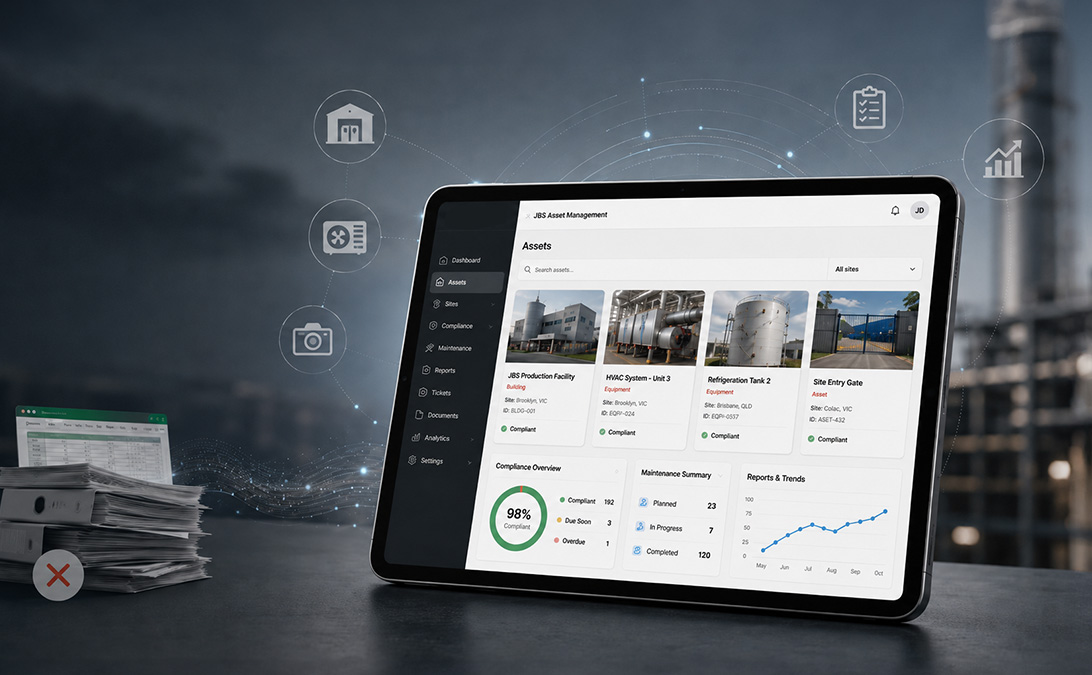
The administration portal acts as the operational hub for the entire system. Administrators can manage customers, buildings, assets, surveyors, report templates, manufacturers, classifications, and survey activity from a single location.
The platform allows teams to:
- Import asset registers from CSV files
- Map client data to system fields
- Assign surveyors to buildings
- Schedule surveys
- Monitor project progress
- Configure reporting templates
- Manage report versions
This web app development solution provided a clearer picture of operational activity while reducing the amount of manual administration required.
2. An offline-first surveyor mobile app
For engineers working on-site, we developed a dedicated mobile application designed around the realities of field work. Once survey data is synchronised to the device, surveyors can continue working without an active internet connection.
Within the application, users can:
- View assigned buildings
- Verify assets
- Add newly discovered assets
- Capture photos and videos
- Record notes and observations
- Update asset information
- Track survey progress
- Resume surveys at any time
When connectivity becomes available, updates are synchronised back to the central platform automatically.
3. Automated report generation capabilities
Reporting was another important part of the project. Survey findings, media, classifications, and templates are brought together to generate structured reports in a consistent format.
The platform also maintains report version history, allowing teams to track changes and download previous versions when required. This removes much of the manual effort traditionally involved in preparing survey documentation.

Technologies used for building web and mobile app
Technology decisions were made based on the way JBS teams actually work rather than simply selecting the latest tools available
1. Flutter for the mobile application
Flutter was selected for the surveyor application. This supports a single codebase while providing a consistent experience across supported devices. More importantly, it supports the offline-first functionality required by engineers working in the field.
2. React.js for the administration portal
The administration platform was built using React.js. This provides a responsive and efficient interface for office-based users managing customers, buildings, surveys, and reporting activities.
3. Laravel for running business logic
Laravel powers the core functionality behind the platform, including user management, asset workflows, survey processing, reporting, authentication, and integrations.
4. MySQL and Cloud storage
MySQL provides the structured database used to manage customers, buildings, assets, surveys, and reports.
Media captured during inspections is stored securely in cloud storage, ensuring photographs and videos remain accessible when needed for reporting and verification purposes.
5. Security and offline access
Because engineers often work in areas with poor connectivity, the mobile app was built to work offline and sync data once a connection becomes available. We also implemented two-factor authentication (2FA) to help keep survey and customer data secure. Report versioning was included too, making it easier for teams to track changes and maintain consistent records throughout a project.
How the platform improved operations
The biggest benefit of the solution is consistency.
Surveyors now follow a structured process regardless of the building or client involved. Information can be verified directly within the application rather than being transferred between multiple systems later.
For management teams, the platform provides greater visibility into survey progress, asset verification activity, and reporting status.
The reporting process is also significantly more organised, with structured templates and version control helping maintain consistency across projects.
Most importantly, JBS now has a single environment for managing asset verification projects from start to finish.
Key lessons for facilities and asset management businesses
Many organisations assume their biggest challenge is collecting data. In reality, the challenge is often managing that data consistently once it arrives.
Asset registers vary between clients. Survey requirements differ between contracts. Engineers work in different environments with different constraints. Without a structured process, inefficiencies quickly begin to appear.
By combining field operations, asset verification, and reporting into a single platform, businesses can improve visibility, reduce manual administration, and create more reliable project outcomes.
How chilliapple helps businesses build smarter operational software
For Jaguar Building Services, this project was not just about replacing spreadsheets. It was about building a more practical way to manage asset verification at scale.
chilliapple designed a connected platform that brings surveyors, administrators, assets, buildings, and reporting into one structured workflow. Field teams can work offline. Office teams get better visibility. Reports become more consistent. And the whole process becomes easier to manage as projects grow.
As facilities and asset management work becomes more complex, businesses need systems that fit the way their teams actually operate. That is where bespoke software makes the difference.
With the right platform in place, JBS now has a stronger foundation for managing inspections, verification, and reporting with more control, more consistency, and less manual effort.