





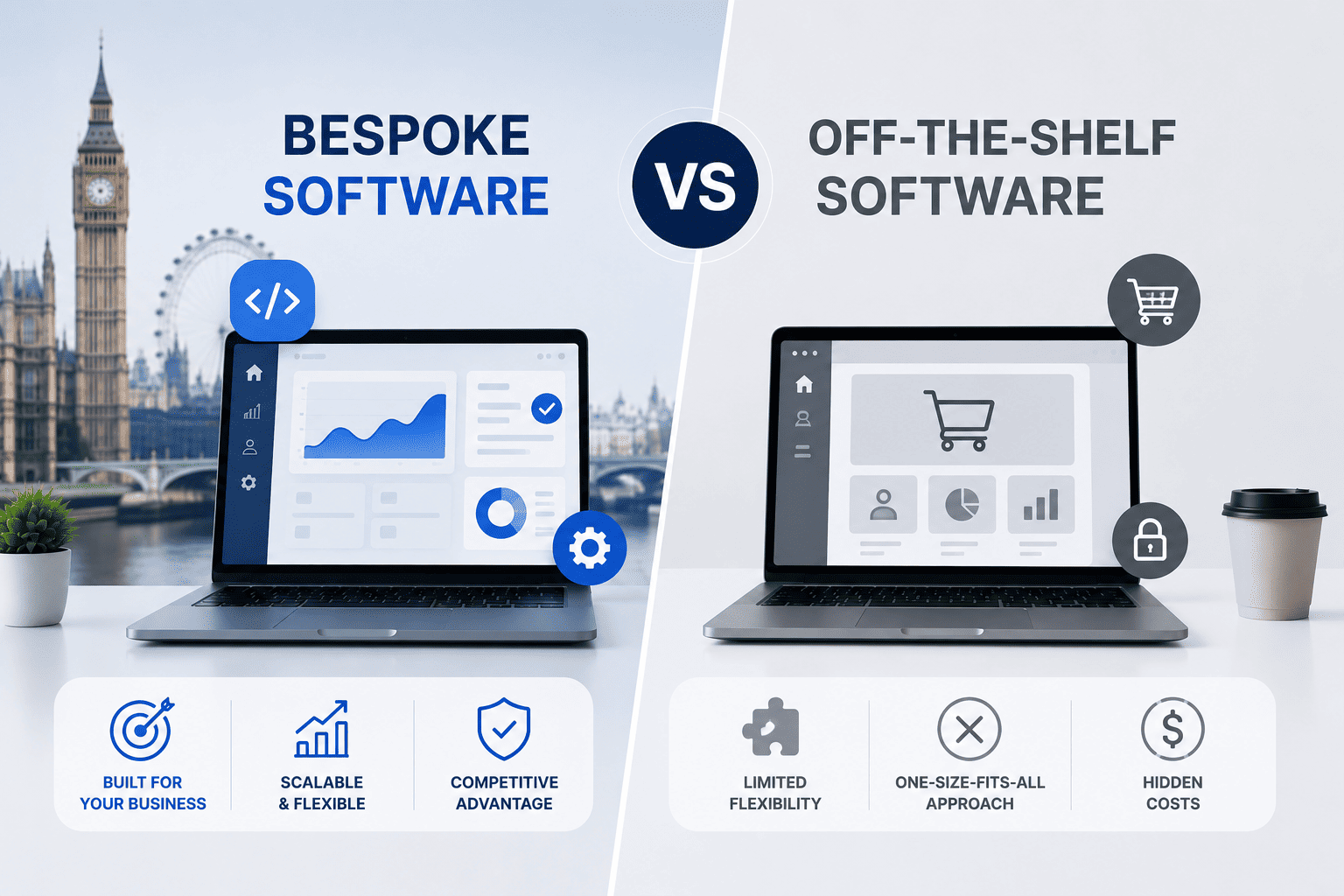
Why Should a UK Startup Invest in Bespoke Software Rather Than Off-the-Shelf Solutions?
Blog Detail

Last Updated on
Most UK startups start with off-the-shelf tools. Which makes sense when you need speed, not a six-month software project. But at some point, usually when you start growing, those tools start showing their limits. Licence costs jump. Workarounds pile up. A client wants an integration your SaaS platform just cannot do.
This is where a lot of founders start seriously thinking about bespoke software. And it is worth thinking about carefully. Gartner forecasts global IT spending to hit $5.61 trillion in 2026, with software alone growing 14.2% to $1.24 trillion. Businesses are clearly moving away from one-size-fits-all platforms.
If you are a UK B2B startup wondering whether a bespoke software development agency is right for you, this guide can help.
What is Bespoke Software Development?
Bespoke software is built around your operations, workflows, and client experience, not a white-labelled SaaS tool with a personalised login page. Every element is designed around your needs, not a vendor’s assumptions.
It doesn’t always mean building from scratch. Linking existing systems, adding custom modules, or creating specific tools can help your team work faster with fewer manual processes.
For many startups, this starts with a focused web app development project, a client portal, dashboard, or workflow tool built to solve one clear problem.
Bespoke vs Off-the-Shelf: What Actually Differs
| Factor | Bespoke Software | Off-the-Shelf Software |
| Upfront Cost | Higher initial investment | Lower to get started |
| Long-Term Cost | Fixed — no licence scaling | Grows with users and add-ons |
| Ownership | Full IP — yours outright | Licence only, no ownership |
| Flexibility | Matches your exact process | You adapt to the vendor’s logic |
| GDPR / Compliance | Built in from day one | Depends on vendor configuration |
| Competitive Edge | Rivals cannot replicate it | Available to every competitor |
| Scalability | On your terms | Subject to vendor tier structure |
The upfront cost row is real; for many early-stage startups, it is the deciding factor. But as you grow, the rows below it tend to become progressively more consequential.
The Hidden Costs of Off-the-Shelf Tools
Off-the-shelf software may look affordable at first, but the hidden costs quickly add up. Licence fees are usually tied to user numbers, not business value, so costs rise sharply as your team grows. Add-ons, integrations, and higher tiers can turn a simple SaaS stack into a major operating expense.
Fit is another issue. Teams often have to change their processes or rely on clumsy workarounds. Then there is vendor dependency. You do not own the code or control the roadmap, leaving you exposed to price rises, removed features, or shutdowns. What starts as a cheap fix can become expensive, rigid, and limiting over time.
Why should UK startups consider bespoke software over off-the-shelf solutions?
Every one of your competitors can access the same off-the-shelf tools. Salesforce, HubSpot, and Monday are commodity platforms. They lower the barrier to entry for everyone equally. They do not create differentiation.
Bespoke software does.
When your platform is built around the exact way your business delivers value, it becomes genuinely hard to replicate. A competitor can copy your pricing or your marketing. They cannot easily copy a proprietary client portal, a custom reporting dashboard, or a web app development project that integrates directly into your clients’ systems.
This carries real weight in B2B sales. Procurement teams and IT leads notice whether your tooling is a stitched-together collection of SaaS subscriptions or a purpose-built platform. The latter signals operational maturity and long-term viability, both of which matter at contract stage.
chilliapple has been building bespoke software for UK businesses since 2008. The pattern we see consistently is that businesses that invest in custom tooling at the right moment pull ahead operationally in ways that compound over time.
GDPR, Data Sovereignty, and UK Compliance
For UK startups in regulated sectors, finance, recruitment, healthcare, legal, or anything handling personal data at scale, compliance is not a secondary consideration. It is frequently a procurement prerequisite.
Off-the-shelf platforms are built for global markets. Their compliance configurations meet the broadest regulatory baseline, not the specific requirements your UK enterprise or public sector clients apply.
Bespoke software lets you build UK GDPR compliance into the architecture from day one. Access controls, audit logging, encryption standards, data retention policies, these become deliberate decisions, not settings you hope the vendor has handled adequately. A UK software agency with genuine knowledge of the UK regulatory landscape can structure your build so compliance is demonstrable from the first client conversation, not retrofitted under pressure later.
Ownership: A Real Business Asset
When you build bespoke software with the right partner, you own the intellectual property. The codebase sits on your balance sheet; it can be valued, audited, or transferred in an acquisition. Investors and acquirers understand this; it is a genuine consideration in due diligence.
With off-the-shelf software, you own a licence. The moment you stop paying, access stops. There is no residual asset and no leverage if a vendor renegotiates terms.
One practical note: always confirm full IP transfer in writing before any build begins. Reputable agencies make this explicit from the outset. At chilliapple, your code is yours; this is standard in every engagement, not something you negotiate for separately.

When Does Bespoke Actually Make Sense?
Honestly, more often than most startup founders expect.
The common assumption is that bespoke is something you graduate to, once you are bigger, more funded, more established. That is rarely how it works in practice. Some of the most impactful builds we have delivered at chilliapple have been for early-stage businesses with one focused problem that no off-the-shelf product was solving properly.
The clear signals? You are constantly bending a SaaS tool to fit your workflow. Your compliance requirements are too specific for a generic platform. Your clients expect a seamless, branded experience that a cookie-cutter tool will always let down eventually. Or your licence costs are already climbing with no sign of stopping.
The only time we would say hold off is if your requirements are still shifting significantly. Get clear on what you need first, then build. Bespoke is almost always the stronger long-term move for a B2B business that is serious about growth.
What to Look for in a Bespoke Software Development Agency
Choosing the right agency matters as much as deciding to go bespoke in the first place. Here is what to actually look for.
Ask for case studies from businesses at a similar stage or in a similar sector. A relevant portfolio tells you far more than a long list of logos. And do not just read the case studies, ask to speak to those clients directly. Ask them how the agency handled things when something went wrong or the scope changed mid-project. That is where you find out what they are really like to work with.
Pay attention to how they behave during the sales conversation. If an agency gives you a confident fixed price for something complex without asking many questions, that is not a good sign. It means they are guessing. A good UK software agency will flag the unknowns early and require a discovery phase before committing to a full build.
Before you sign anything, make sure the contract is clear on three things: who owns the code, what support looks like after launch, and what happens to the codebase if you ever part ways. These should not be things you have to ask for, a trustworthy agency puts them in writing from the start.
chilliapple has been building bespoke software for UK businesses since 2008 and holds a 4.9 rating on Trustpilot. We will tell you honestly if a custom build is the right move, and if it is, we will build it properly.
Final Thought
The off-the-shelf versus bespoke decision is not permanent, and rarely fixed. Most UK startups use a combination of both at different stages. What matters is recognising when a generic tool is holding your business back, and having a development partner with the experience to build something that genuinely solves the problem.
If you are at that point, connect with us. We have been working with UK businesses on bespoke software development since 2008. Contact us for a consultation.
Frequently Asked Questions
How much does bespoke software development typically cost for a UK startup?
A focused bespoke software build typically starts from £15,000. More complex platforms cost more. But when you factor in SaaS licence fees, add-ons, and workaround costs over three to five years, bespoke usually works out cheaper in the long run.
How long does a bespoke software build take?
Most builds take a minimum of 8 weeks from start to deployment. The biggest cause of delays is not the development; it is poorly defined requirements going in. A solid discovery phase at the beginning keeps everything on track.
How to choose the right bespoke software provider for your business?
Ask for references from comparable businesses and verify them. Watch how they handle scope uncertainty; honest agencies flag complexity early. Confirm full IP transfer and post-launch support before signing. Never choose on price alone.
Can bespoke software integrate with existing business systems easily?
Yes, when built correctly. A good agency designs for integration from the outset, connecting your CRM, ERP, or third-party tools through APIs. Defining integration requirements clearly during the discovery phase prevents expensive retrofitting later.
What industries benefit most from custom software solutions?
Finance, legal, healthcare, recruitment, and logistics tend to get the most out of bespoke; these are sectors where compliance is tight, workflows are specific, and a generic tool almost always forces some kind of compromise. That said, any B2B business where the software is central to how you deliver your service is a strong candidate. If off-the-shelf is making you work around it rather than with it, that is your answer.