






Last Updated on
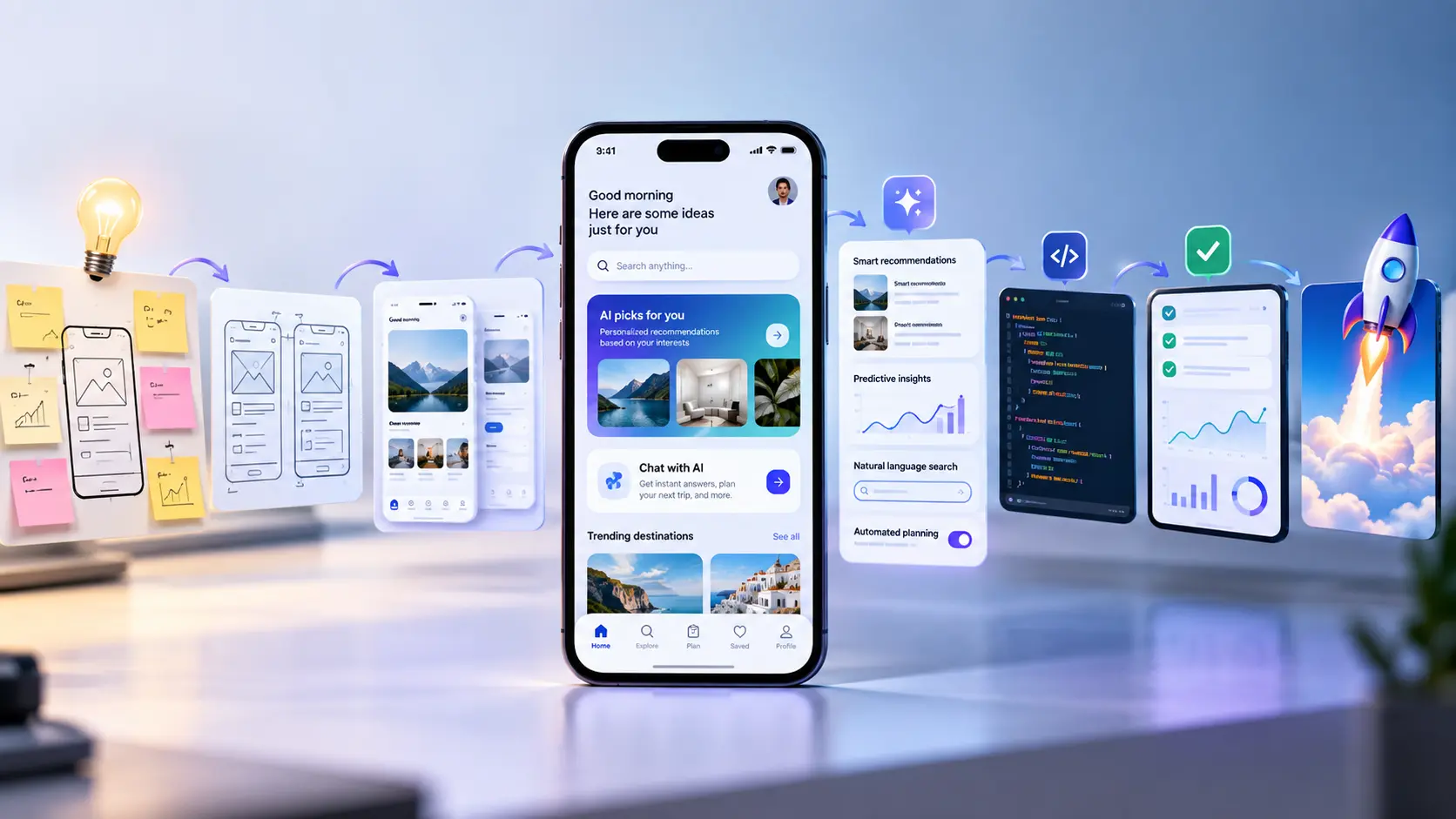
Building an app includes ideation and validation of the idea, identifying the AI use cases, choosing the right AI approach, developing the core functionalities, designing the user interface, testing the MVP, and finally monitoring and additional development after launch.
An idea for an app can sound amazing in your head. Building it is a different job entirely. Between your idea and launching on the App Store sits a long list of decisions. Getting from what the app should actually do to how to build something people trust and keep using is a long journey. AI has made parts of this faster, but it hasn’t removed the need for a clear plan.
AI adds both new possibilities as well as complexity. To make this a success, it is important to have the right roadmap in place and understand what the process is. Along with that, what is even more important is to partner with the right AI development company.
This guide will walk you through the entire process from identifying business goals to monitoring AI applications in production.
What Makes an AI-Powered Mobile App Different?
While traditionally mobile apps followed fixed rules, AI-powered applications work differently. For example, a traditional app would respond the same way every time. But the AI-backed app learns from data, makes predictions, and can respond in ways that change from one user to the next. This shift is what makes AI-incorporated applications widely adopted by businesses.
Artificial intelligence isn’t just a new feature to add in. It is becoming the engine behind how modern apps deliver smarter experiences and drive business growth. Here is what makes an AI-integrated mobile application a better option in the current market.
- AI-powered search
- Predictive notifications
- Document analysis
- Quicker service and support
- Enhanced operational efficiency
- Fraud detection
- Informed business decision-making
- Predictive forecasting
- Unmatched user experience
- Automating recurring tasks
Application development backed by AI combines data analysis and personalisation resulting in business growth.
Step-by-Step Process to Build an AI-Powered Mobile App
While AI adds to the functionalities, it brings in certain complexities. To deal with it, a well-structured development process is a must.
Step 1: Validate the App Idea and AI Use Case
Your idea lays a solid foundation for a successful app. It is important to have a clear purpose, problem to be solved, target audience, functionalities to include, etc., to make the process a success.
Understanding the market and the existing solutions, and checking what competitors are doing better, is essential. Your app idea should plug the gap that your competitors are failing to address.
Make sure the app is actually required in the market before you begin your development process. Surveys, landing pages with email signups, and non-functional prototypes are a few ways to evaluate this.
Step 2: Planning and AI Approach
The right development partner will start work by gathering your requirements and planning the project roadmap based on that. A great way to shortlist functionalities and features is to prioritise them based on nice-to-haves, must-haves, and future additions.
Traditional apps have different planning requirements, while AI apps require considering accessible data, using pre-trained or custom models, ethical implications of AI, etc.
The planning process includes deciding upon the platform. Whether you want your app for iOS and Android, a web-based application, or both. This influences the use of the technology stack and the final design choices.
Other than functionalities and technology stack, it is important to plan for milestones, project timelines, etc., for better guidance throughout the development process.

Step 3: Data Collection
AI-powered app development requires a sound data strategy and collection. Segregating the types of data an AI model will require gives the process direction. Also, determining the ultimate source of data retrieval is important. Decide whether you are using publicly available data or creating your own proprietary data.
Data cleaning, labeling and structuring is also important as raw data is messy and needs to be formatted correctly for AI models. Your development team needs to work with you to ensure that your data collection and storage practices are fully compliant with the relevant regulations.
Step 4: AI Model Development
This step covers the core of the development process and includes building the intelligence of your app. There are options to use a pre-trained model or opt for a custom-built model.
The pre-trained model is a faster option, while a custom build offers better control and can be tailored to specific needs. Many AI applications are built using existing foundation models, APIs, retrieval systems, orchestration layers, or other pre-trained capabilities without training a model from scratch.
After the model application and validation, it is important to align the output to the business objectives. This is to ensure that the model’s predictions or classification cater to the ultimate business needs and user intent.
Step 5: App Architecture
Strong development requires a user-centric interface, as designing for AI requires a unique approach. The backend should be able to support the AI models and scale accordingly.
For smooth pairing of frontend, backend, and AI model, clean and efficient APIs are a must. This stage also involves planning cloud infrastructure and setting up DevOps pipeline, as it ensures continuous integration and deployment.
Step 6: First Working Version and Testing
After the first version is all set to be tested, it is analysed within the internal team for any bugs, usability issues, and stability.
Step 7: User Testing and Refinements
Internal testing is then followed by controlled environment user testing and feedback implementations. At this stage, your development partner gathers the information and makes recommendations for refinement based on user feedback.
AI apps require more than conventional software testing, including functional testing, relevancy check, API testing, platform testing, etc.
Step 8: Launch and Maintain
Once development is complete, it is time to launch and continue to monitor the performance of the app. AI models are prone to glitches and require regular monitoring and updates.
Common AI App Development Mistakes to Avoid
Even well-funded projects with an out-of-the-box concept can go off track. These are the mistakes that show up most often when building an AI-powered mobile app, and how to avoid them.
Adding AI for the sake of it
Integrating AI isn’t just another technology adoption. It is important to ensure that it actually brings in the right value. If a feature doesn’t solve the purpose, then adding it is a waste. You need to decide what AI can best solve for you.
Skipping validation
Your idea might sound like a hit, but validating and testing it is important. Connecting with your future users, testing a prototype, and launching a focused MVP first can be a great way to save time, effort, and unnecessary investment.
Ignoring data quality
An AI model works best based on the data behind it. If it’s using incomplete, biased or outdated data, it can turn out to be a disaster. It’s vital you invest time in collecting, cleaning and organising data before development even begins.
Incorrect AI approach
Opting for a custom-trained model, even when pre-built APIs can do the work or vice versa, can cost you unnecessary time, effort, and overall performance.
Neglecting privacy and security
AI apps usually process crucial personal data, and this requires consent, encryption, and compliance to avoid any legal trouble and loss of user trust.
Conclusion
The journey to bring an app development idea into existence involves risk and with AI integration, complexities increase. Therefore, the right development approach and a trusted AI UK consultancy are the key factors. The successful applications aren’t always the ones with the flashiest technology, but they are the ones with a clear plan and the right implementation.
From first idea to production, build your AI-powered mobile app with the right development partner. Get in touch with chilliapple and bring your AI app idea into reality.
FAQs
Q1. How much does AI mobile app development cost?
The pricing for app development powered by AI varies depending on the functionalities and complexities. However, generally the overall development price ranges from £10,000 to £400,000+. The majority of application development projects falls between £40,000 and £150,000.
Q2. How long does it take to build an AI app?
The timeframe for a basic custom AI-powered mobile app development can take anywhere from 3 to 18 months depending on the functionalities and features. However, enterprise apps or apps requiring major integrations can take even longer.
Q3. What AI technologies are used in mobile app development?
While the tech stack varies depending on your needs, the common technologies used include machine learning, natural language processing, computer vision, and generative AI.