




Generative AI Vs. Agentic AI: The Key Differences Everyone Needs To Know
Blog Detail

Last Updated on
For most businesses, AI adoption didn’t start with a strategy. It started with experimentation. Someone tested a tool, saw value, and gradually more teams followed. That early wave was driven by generative tools for content creation, summaries, and quick answers.
Today, that phase is shifting. Conversations are moving beyond output and into execution. That’s where Generative AI vs. Agentic AI becomes a practical business discussion. Organisations exploring Gen AI development services are now asking a different question: what can AI actually do without constant input?
Understanding that distinction is where real decisions begin. Many organisations are now realising that early AI adoption solved surface-level inefficiencies but did not fundamentally change how work moves across teams or systems.
Gen AI vs. Agentic AI – a simple way to understand the shift
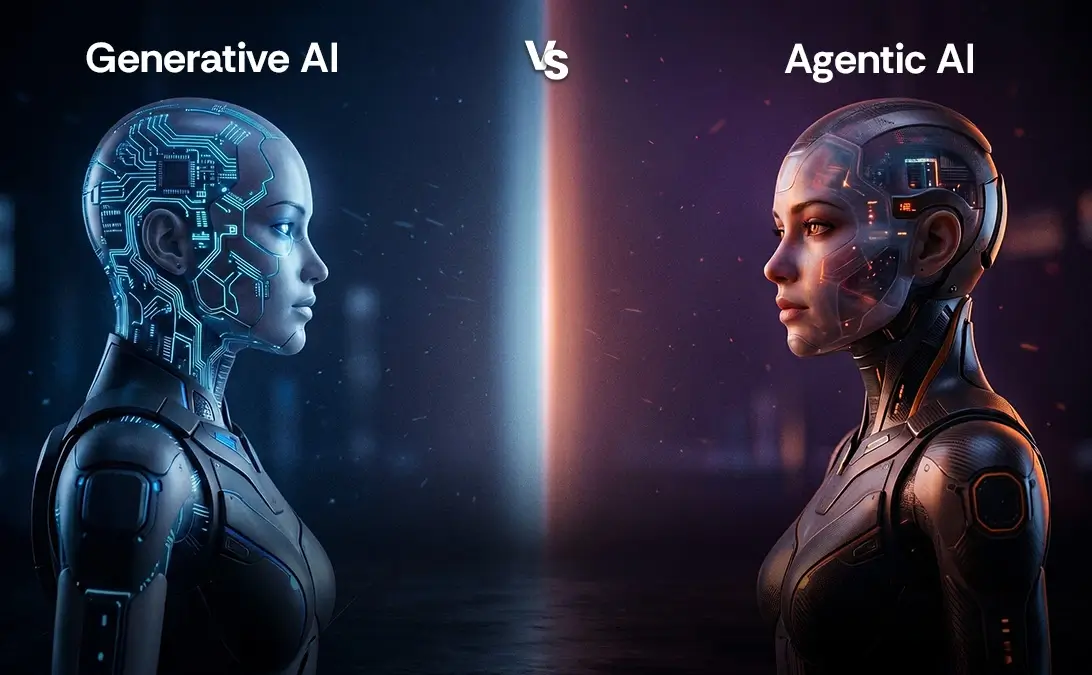
The easiest way to think about Generative AI vs. Agentic AI is this:
Generative AI responds → It creates content. Generative systems are built around prompts. You ask, it answers. You refine, it improves. The interaction is direct and controlled.
Agentic AI acts → It completes tasks and workflows. Agentic systems operate differently. You define a goal, and the system works toward it—often across multiple steps, tools, and decisions, with limited intervention.
This distinction may seem straightforward at first glance, but in real business environments, it directly affects how:
- Teams operate
- Systems integrate
- Outcomes are delivered
In practical terms, this means shifting from isolated task completion to continuous execution. So, artificial intelligence becomes an integral part of the workflow.
What is Generative AI, and what does it do well?
Generative AI is a type of artificial intelligence designed to create new content based on patterns learned from large datasets. It responds to prompts and generates outputs such as text, code, or summaries.
It’s now familiar territory and is used across teams for:
- Drafting documents and emails
- Summarising large volumes of information
- Writing code snippets
- Translating or simplifying technical content
At its core, it works on pattern recognition. It has learned from large datasets and uses probability to generate outputs that resemble human work. The strength here is speed and accessibility. Tasks that once took hours can now be completed in minutes.
But there’s a limitation. It doesn’t move forward unless someone tells it to. That’s why, in real business workflows, generative AI often sits as a tool—not a system. According to McKinsey, generative AI can automate up to 60–70% of activities employees spend time on.
What is Agentic AI and what does it do well?
Agentic AI is a type of artificial intelligence that can work towards a goal by managing multiple steps and tasks with limited human input. It takes a different approach. Instead of waiting for prompts, it operates around objectives.
You give it a goal. It plans the steps. It uses tools. It adapts if something changes. And it continues until the task is complete or requires human input.
This is where Generative AI vs. Agentic AI becomes more than a technical comparison. It becomes a shift in how work is structured.
For example, a generative system might draft an email.
An agentic system might:
- Identify when a follow-up is needed
- Gather relevant customer data
- Draft the email using generative AI
- Send it
- Update the CRM
All from one instruction. This shift reduces operational friction and removes the need for constant manual coordination between steps. Some of the best AI tools to enhance productivity are ChatGPT, Copilot (Microsoft), Gemini (Google) and Claude, among others.

Comparison table: Generative AI Vs. Agentic AI
| Aspect | Generative AI | Agentic AI |
| Core Function | Content creation | Task execution |
| Interaction | Prompt-based | Goal-based |
| Workflow | Single-step | Multi-step |
| Autonomy | Low | High |
| Role | Tool | System |
| Output | Text, code, media | Completed processes |
| Dependency | Human-driven | Semi-autonomous |
Why businesses are starting to care now
For a while, generative AI delivered quick wins. Content teams, developers, analysts—all saw immediate benefits.
But as usage matured, limitations became clearer:
- Too much manual orchestration
- Repetitive prompting
- No continuity between tasks
- Limited integration with existing systems
That’s where the interest in agentic models is coming from. An AI development agency working with mid-sized or scaling businesses is now seeing a pattern. Companies don’t just want AI to assist. They want it to reduce operational load.
This shift reflects a broader move from efficiency gains to operational redesign, where businesses are looking to simplify how work actually flows. That means fewer handoffs. Fewer repeated inputs. More continuity across tasks.
Gen AI use cases
Drafting and content creation: Generative AI helps teams quickly create emails, reports, and proposals. This helps to reduce time spent on first drafts. Moreover, it ensures consistency in tone and structure.
Marketing content and blogs: It supports marketing teams in generating blogs, social posts, and campaign content. This makes it easier to scale content production.
Data summarisation: Generative AI can process large datasets or documents. It can turn them into concise summaries. So, it helps teams to extract insights faster without going through every detail manually.
Code writing and review: Developers use generative AI to write code snippets, debug issues, and review logic. This improves development speed while still relying on human validation for accuracy.
Translation and simplification: It can translate languages and simplify complex technical information. So, making content for different audiences is feasible for the marketing teams.
Agentic AI use cases
Customer follow-ups and CRM automation: Agentic AI can track interactions and trigger follow-ups. It can generate messages and update CRM systems automatically. This reduces the manual effort and ensures timely engagement with customers.
Onboarding workflow management: It manages onboarding across systems by collecting data and verifying inputs. It coordinates tasks and ensures a smooth process without constant human intervention.
Invoice processing and approvals: Agentic AI can validate invoices. It can match them with records, route approvals, and initiate payments. This helps finance teams to reduce errors and speed up processing cycles.
Compliance and regulatory monitoring: It continuously tracks regulatory changes and identifies impact areas. It can also trigger required actions that help organisations stay compliant. This eliminates the need to rely on manual monitoring.
Multi-step project coordination: Agentic AI can manage project workflows by coordinating tasks, assigning actions, and tracking progress across tools. It ensures processes move forward without constant oversight.
Agentic AI vs. Generative AI: Which one fits in practice
Rather than replacing each other, these technologies often work together.
Generative AI fits best when:
- You need quick outputs
- Tasks are discrete and well-defined
- Human review is expected
- Creativity or variation matters
Agentic AI fits best when:
- Work involves multiple steps
- Systems need to interact
- Decisions follow defined logic
- Processes repeat frequently
In many cases, agentic systems actually use generative AI as one part of their workflow.
Conclusion
The most effective AI strategies won’t choose between them. They’ll combine both. For example, Generative AI handles thinking and creation. Similarly, Agentic AI handles planning and execution.
Together, they create systems that don’t just respond but actually move work forward. And that’s the real shift.